I've been making a bunch of comments on Computer Science education lately. The New York Times has an excellent article about "Making Computer Science More Enticing" which focuses on Stanford's new curriculum. The Stanford curriculum is very similar to IU's new specialization-based curriculum and seems to be an excellent approach to "teaching the discipline".
Also, I found the "definitive" document on CS education - The ACM/IEEE Computing Curriculum 2008 Update [PDF].
Why so much focus on education? Computer Science is a (relatively) new discipline with a multitude of high-impact applications, giving us an imperative to train students quickly. Unfortunately, the speed at which our field is moving can cause us to lose sight of the philosophy behind the science.
If someone wants to learn Biology, you would point them to Campbell & Reece. If someone wants to learn computation, where do you point them? A list of books. There are books focused on introducing algorithms and functional programming (SICP); there are tomes focused on general computation (Knuth); there are books focused on application (the entire O'Reilly library); there are definitive texts on specific languages (The C Programming Language, The Scheme Programming Language); there does not seem to be a widely-accepted, integrative introduction that emphasizes computation -- algorithms and models. From what I'm observing in CS curricula across the country, the coursework is moving in this direction, but we still need this cohesive "Introduction to Computing" book.
As a final message, this video linked in the NYT article captures the beauty, richness and excitement of our discipline right now -- "It's sort of like you're geometers and you're living in the time of Euclid":
Sunday, February 21, 2010
Tuesday, February 16, 2010
Computer Studies
The latest issue of Communications of the ACM, the premier computer science journal contains an interesting article by IU Professor Dennis Groth -- Why an Informatics Degree? The article has much to say about the necessity of application and applied computing as a measure of computer science success.
However, there are some questions left unanswered and one answered incorrectly. First, I address two questions in philosophy of science: "What is Computer Science?" and "Why Informatics?" I then address the pedagogical implications of these questions in a section on "Computer Studies".
This conflation of implementation and quantum is extremely pervasive. For example, Biology is "the study of life", but in a (typical) biology class one never addresses the basic question: "What is life?" The phenomena of life can be studied independently of the specific carbon-based implementation we have encountered. This doesn't deny the practical utility of modern biology, but it does raise the question of how useful our study of the applied life is to our understanding of life itself. (If you're interested in this line of questioning, I highly recommend Larry Yaeger's course INFO-I486 Artificial Life.)
Similarly, Computer Science can study procedures independently of the hardware and software implementations. Consider the sorting problem. (If you are unfamiliar with sorting, see the Appendix: Sorting Example.) One would not start by looking at processor architecture or software deisgn, but would instead focus on the algorithm. Pure Computer Science has nothing to do with hardware or software, they are just an extremelypractical medium on which we experiment.
The first definition defines a methodology but does not define a subject. It should be obvious that we live in a collaborative, interdisciplinary world. Fields should inform one another but there is still a distinction between fields: Biology studies life; Computer Science studies computation; Cognitive Science studies cognition; Chemistry studies chemicals; etc. One can approach any problem with any number of techniques - computing is one part of this problem-solving toolkit, along with algebra, calculus, logic and rhetoric. However, each of the particular sciences should answer some natural question - whether that be a better explanation of life, computation, mathematics or cognition. Positing a discipline as the use of one field to address problems in another field is not a new field. It's applied [field] or [field] engineering.
The other definition, that informatics studies the interaction of people and technology, hints at a new discipline studying a quantum of "interaction". This area has tons of exciting research, especially in human-computer interaction (HCI) and epidemiology. Further emphasizing this would go a long ways toward creating a new discipline and set a clear distinction between the informaticist and the computer scientist. Computer scientists study computation; informaticists study interaction; both should be encouraged. As it stands, both study "computers" and both step on each other's toes.
However, as currently implemented at IU, the Informatics curriculum is a liberal arts degree in technology. Formal education should teach either a vocation, a discipline or (ideally) both. Informatics seems to answer to neither claim by emphasizing how informaticists "solve problems with computers" without diving into programming or modeling. If it aims to teach such a vocation, then more application is necessary to give expertise; if it aims to teach a discipline, it is fine to do that through application, but we must recognize that application is only useful insofar as it benefits theory (and vice versa). Additionally, if the field does indeed have a quantum of interaction, then interaction should be the forefront of the curriculum.
IU's Computer Science ex-department is a valiant effort to teach a discipline - in the span of 4 years we cover at least 3 distinct programming paradigms (functional, object-oriented and logic) spread over 4 distinct languages, bristling with an exploration of algorithms. That being said, I would be surprised if more than 25% of the graduating class could explain a Turing Machine.
Not everyone is into theory - most people really just want to "solve problems with computers" and have a good job. Where do these programmers go? Informatics does not address this challenge, and shouldn't attempt to. The answer is software engineering - just as applied physics finds a home in classical engineering. By establishing a third program for those clearly interested in application, IU would have a very solid "computer studies" program (as distinguished from computation or technology). [A friend has pointed out that IU cannot legally offer an engineering degree, so we'd have to get creative on the name or tell people to go to Purdue. This works as a general model of Computer Studies pedagogy.]
As another example of how to split "computer studies", Georgia Tech recently moved to a three-prong approach with the School of Computer Science (CS), School of Interactive Computing (IC), and Computational Science and Engineering Division (CSE). My view of Informatics roughly correlates to that of IC; the Computer Science programs are equivalent but include software engineering. The CSE division is a novel concept, presently captured by IU's School of Informatics, and it seems this is another working group, but I feel it is best captured by adjunct faculty and interdisciplinary programs, rather than a whole new field.
However, there are some questions left unanswered and one answered incorrectly. First, I address two questions in philosophy of science: "What is Computer Science?" and "Why Informatics?" I then address the pedagogical implications of these questions in a section on "Computer Studies".
What is Computer Science?
Any new discipline needs to consider its philosophy in order to establish a methodology and range of study. Prof. Groth's definitions of Computer Science and Informatics do not quite capture these considerations:Computer science is focused on the design of hardware and software technology that provides computation. Informatics, in general, studies the intersection of people, information, and technology systems.In explicitly linking the science to its implementation, this definition of Computer Science fumbles away its essence. Yes, the technology is important and provides a crucial instrument on which to study computation, but at its core computer science studies computation -- information processing. Computer science empirically examines this question by studying algorithms (or procedures) in the context of a well-defined model (or system).
This conflation of implementation and quantum is extremely pervasive. For example, Biology is "the study of life", but in a (typical) biology class one never addresses the basic question: "What is life?" The phenomena of life can be studied independently of the specific carbon-based implementation we have encountered. This doesn't deny the practical utility of modern biology, but it does raise the question of how useful our study of the applied life is to our understanding of life itself. (If you're interested in this line of questioning, I highly recommend Larry Yaeger's course INFO-I486 Artificial Life.)
Similarly, Computer Science can study procedures independently of the hardware and software implementations. Consider the sorting problem. (If you are unfamiliar with sorting, see the Appendix: Sorting Example.) One would not start by looking at processor architecture or software deisgn, but would instead focus on the algorithm. Pure Computer Science has nothing to do with hardware or software, they are just an extremelypractical medium on which we experiment.
Why Informatics?
Informatics seems to be ahead of itself here in asking "Why an Informatics degree?" before asking the more fundamental "Why Informatics?" There are two primary definitions implied in the article. The more popular answer is that "Informatics solves interdisciplinary problems through computation". The second, emerging answer is that "Informatics studies the interaction of people and technology".The first definition defines a methodology but does not define a subject. It should be obvious that we live in a collaborative, interdisciplinary world. Fields should inform one another but there is still a distinction between fields: Biology studies life; Computer Science studies computation; Cognitive Science studies cognition; Chemistry studies chemicals; etc. One can approach any problem with any number of techniques - computing is one part of this problem-solving toolkit, along with algebra, calculus, logic and rhetoric. However, each of the particular sciences should answer some natural question - whether that be a better explanation of life, computation, mathematics or cognition. Positing a discipline as the use of one field to address problems in another field is not a new field. It's applied [field] or [field] engineering.
The other definition, that informatics studies the interaction of people and technology, hints at a new discipline studying a quantum of "interaction". This area has tons of exciting research, especially in human-computer interaction (HCI) and epidemiology. Further emphasizing this would go a long ways toward creating a new discipline and set a clear distinction between the informaticist and the computer scientist. Computer scientists study computation; informaticists study interaction; both should be encouraged. As it stands, both study "computers" and both step on each other's toes.
Computer Studies
This discussion of philosophies has important implications for how we structure computer-related education (formalized as Computer Studies). Despite major differences in our approaches, it does seem clear that Computer Science and Informatics should work together, especially in applications.However, as currently implemented at IU, the Informatics curriculum is a liberal arts degree in technology. Formal education should teach either a vocation, a discipline or (ideally) both. Informatics seems to answer to neither claim by emphasizing how informaticists "solve problems with computers" without diving into programming or modeling. If it aims to teach such a vocation, then more application is necessary to give expertise; if it aims to teach a discipline, it is fine to do that through application, but we must recognize that application is only useful insofar as it benefits theory (and vice versa). Additionally, if the field does indeed have a quantum of interaction, then interaction should be the forefront of the curriculum.
IU's Computer Science ex-department is a valiant effort to teach a discipline - in the span of 4 years we cover at least 3 distinct programming paradigms (functional, object-oriented and logic) spread over 4 distinct languages, bristling with an exploration of algorithms. That being said, I would be surprised if more than 25% of the graduating class could explain a Turing Machine.
Not everyone is into theory - most people really just want to "solve problems with computers" and have a good job. Where do these programmers go? Informatics does not address this challenge, and shouldn't attempt to. The answer is software engineering - just as applied physics finds a home in classical engineering. By establishing a third program for those clearly interested in application, IU would have a very solid "computer studies" program (as distinguished from computation or technology). [A friend has pointed out that IU cannot legally offer an engineering degree, so we'd have to get creative on the name or tell people to go to Purdue. This works as a general model of Computer Studies pedagogy.]
As another example of how to split "computer studies", Georgia Tech recently moved to a three-prong approach with the School of Computer Science (CS), School of Interactive Computing (IC), and Computational Science and Engineering Division (CSE). My view of Informatics roughly correlates to that of IC; the Computer Science programs are equivalent but include software engineering. The CSE division is a novel concept, presently captured by IU's School of Informatics, and it seems this is another working group, but I feel it is best captured by adjunct faculty and interdisciplinary programs, rather than a whole new field.
Appendix: Sorting Example
Let's say we have a list of numbers and want to sort them from smallest to largest. One naive way is to compare each term to the next one, and swap them if they are in the wrong order and restart until you can make it to the end without swapping:1: *4 3* 2 1 -> 3 *4 2* 1 -> 3 2 *4 1* -> 3 2 1 4 2: *3 2* 1 4 -> 2 *3 1* 4 -> 2 1 *3 4* -> 2 1 3 4 3: *2 1* 3 4 -> 1 *2 3* 4 -> 1 2 *3 4* -> 1 2 3 4 4: *1 2* 3 4 -> 1 *2 3* 4 -> 1 2 *3 4* -> 1 2 3 4
This is called bubble sort, and solves the problem of sorting. However, consider what you'd have to do to sort a bigger list: each time you make a swap you have to rescan the whole list! A smarter way to sort this list would be to divide the list into two smaller lists, sort the smaller lists, and then merge them together:
1a: *4 3* -> 3 4
1b: *2 1* -> 1 2

Now merge by comparing the items in each list:
2a: *3* 4 -> *3* 4 -> 1 2 3 4
2b: *1* 2 -> 1 *2* -^
This only takes 4 comparisons, compared to 12! We just did a classic problem in Computer Science without even once mentioning computer hardware or writing a single line of code!

Monday, January 25, 2010
One Year Later
With the state of the union address rapidly approaching, I want to highlight some excellent articles bringing Obama's first year into perspective. Many people have become disheartened by the lack of swift action by the administration on many topics - health care, Iraq, the economy, etc. I'd encourage you to read Andrew Sullivan's article: Obama's Substantive First Year:
All that is great - things have been getting done... so what's our problem with Obama? The New Yorker addresses this succinctly - One Year: Storyteller-in-Chief:
 , anyone?).
As for me, I remain optimistic about the future of the administration. A great deal of current frustrations have to do with participation. 2008 was a never-ending deluge of political news and activism. Working for the campaign and delivering Indiana was the highlight of my year. In 2009 our nation had to unwind and reconcile our own drive for action with the notion that legislating is a full-time job, requiring a ton of expertise. The government is huge and most people don't have time to read every bill, to learn the details of every issue - that's why we are a representative democracy. I think a large part of liberal frustration comes from a headstrong dislike of delegation. We have to let those we elected do their job; our role as citizens is to give them feedback through our communications and then our votes.
From the inaugural address Obama knew he faced a myriad of difficult problems:
Obama is a liberal pragmatist in politics and a traditional conservative in his understanding of the presidency. Once you grasp this, his first year makes much more sense.The article highlights Obama's strengths and shortcomings in a calm, collected manner. Further reading on the year's accomplishments:
- For more details on Obama's military approach, I highly reccomend Wired's excellent profile of Secretary Gates back in September.
- GOOD Magazine ran an excellent infographic giving historical perspective to the first 100 days.
- Daily Kos also has a list of 90 Accomplishments of Pres. Obama which the Media Fails to Report.
All that is great - things have been getting done... so what's our problem with Obama? The New Yorker addresses this succinctly - One Year: Storyteller-in-Chief:
I’ve been an Obama man all the way. I voted for him in 2008 and I’ll vote for him again in 2012, with far less enthusiasm. But it would help me out so much if he could give me some kind of story to hang onto. At this stage, a scrap would suffice. A President can have all the vision in the world, be an extraordinary orator and a superb politician, have courage and foresight and a willingness to make painful choices, have a bold progressive plan for his nation—but none of these things will matter a wit if the President cannot couch his vision, his policies, his courage, his will, his plan in the idiom of story.People need stories to latch on to and remembering our personal narrative is vital to projecting our future. Obama would be wise to heed these words: after all, so much of his meteoric rise comes from his extraordinary storytelling (Dreams from My Father
, anyone?).As for me, I remain optimistic about the future of the administration. A great deal of current frustrations have to do with participation. 2008 was a never-ending deluge of political news and activism. Working for the campaign and delivering Indiana was the highlight of my year. In 2009 our nation had to unwind and reconcile our own drive for action with the notion that legislating is a full-time job, requiring a ton of expertise. The government is huge and most people don't have time to read every bill, to learn the details of every issue - that's why we are a representative democracy. I think a large part of liberal frustration comes from a headstrong dislike of delegation. We have to let those we elected do their job; our role as citizens is to give them feedback through our communications and then our votes.
From the inaugural address Obama knew he faced a myriad of difficult problems:
Today I say to you that the challenges we face are real. They are serious and they are many. They will not be met easily or in a short span of time. But know this America: They will be met.We still face serious challenges, but fortunately we have three (hopefully seven) more years. Let's recognize those challenges "future work" and take solace what's already been accomplished in this short portion of the excruciatingly slow march of progress. My hope for the State of the Union is that it frames our current challenges in the "unlikely story that is America", reasserting that once again we will meet and far surpass our challenges.
Thursday, January 21, 2010
Thoughts on Dawkins
Just wanted to highlight an excellent article on Neuroanthropology about Richard Dawkins.
Neuroanthropology: Richard Dawkins on 'Elders'
I saw Dawkins speak in October and was very non-plussed by the whole experience, since then I've wanted to write a very similar article. The article captures what I wanted to say with eloquence. This piece is not just reflective of Dawkins but a larger cultural trend. When he was at IU, he answered a barrage of pretty terrible questions from a mostly groveling audience. ("I am an atheist, but you are my God" was said and is admittedly the most ridiculous exemplar, but the general tone was maintained.)
One of the key problems is that Dawkins seems to rail against a very particular kind of theism - that of the omnipotent, omnipresent "guy in the sky" which can rail down thunder and lightning in a feverish outbreak of fury. I don't think that's what the majority of people conceptualize when they see the divine. When Dawkins answered a question about life's purpose, he got at what a lot of people agree with - a general sense of wonder and marvel at the infinite complexity of life, and the immense grandiosity of the universe.
Also, he asserted that the Pope, the Archbishop of Canterbury, and other religious leaders have no problem with evolution and their faith coexisting. You cannot study biology without evolution, and to accept creationism as scientific fact is raw ignorance. Instead of focusing arguments on polarization like theism vs. atheism, why not just strike at the core? Ignorance and bigotry are terrible in any incarnation, but are not a direct result of having any theistic conviction.
If Dawkins (and other new atheists) aim to make the world more "scientific" the emphasis should not be on any epistemological claim that replaces religious belief with scientific "belief". Rather, they should teach people to engage the world, to challenge their beliefs, wrestle with them and question them. By teaching people to accept science as something "to believe in", we gain nothing except struggles when scientific "doctrine" is found to be a misunderstanding - as has happened at countless junctures in the history of science. By teaching engagement we can challenge our assumptions boldly and discover the next step on the long path to truth. Carl Sagan puts this desire eloquently on the first pages of Cosmos : "If we long for our planet to be important, there is something we can do about it. We make our world significant by the courage of our questions and by the depth of our answers."
Neuroanthropology: Richard Dawkins on 'Elders'
I saw Dawkins speak in October and was very non-plussed by the whole experience, since then I've wanted to write a very similar article. The article captures what I wanted to say with eloquence. This piece is not just reflective of Dawkins but a larger cultural trend. When he was at IU, he answered a barrage of pretty terrible questions from a mostly groveling audience. ("I am an atheist, but you are my God" was said and is admittedly the most ridiculous exemplar, but the general tone was maintained.)
One of the key problems is that Dawkins seems to rail against a very particular kind of theism - that of the omnipotent, omnipresent "guy in the sky" which can rail down thunder and lightning in a feverish outbreak of fury. I don't think that's what the majority of people conceptualize when they see the divine. When Dawkins answered a question about life's purpose, he got at what a lot of people agree with - a general sense of wonder and marvel at the infinite complexity of life, and the immense grandiosity of the universe.
Also, he asserted that the Pope, the Archbishop of Canterbury, and other religious leaders have no problem with evolution and their faith coexisting. You cannot study biology without evolution, and to accept creationism as scientific fact is raw ignorance. Instead of focusing arguments on polarization like theism vs. atheism, why not just strike at the core? Ignorance and bigotry are terrible in any incarnation, but are not a direct result of having any theistic conviction.
If Dawkins (and other new atheists) aim to make the world more "scientific" the emphasis should not be on any epistemological claim that replaces religious belief with scientific "belief". Rather, they should teach people to engage the world, to challenge their beliefs, wrestle with them and question them. By teaching people to accept science as something "to believe in", we gain nothing except struggles when scientific "doctrine" is found to be a misunderstanding - as has happened at countless junctures in the history of science. By teaching engagement we can challenge our assumptions boldly and discover the next step on the long path to truth. Carl Sagan puts this desire eloquently on the first pages of Cosmos
: "If we long for our planet to be important, there is something we can do about it. We make our world significant by the courage of our questions and by the depth of our answers."
Monday, January 18, 2010
2009 in Music
I've been a member of last.fm (my profile) for almost three years. Last.fm is a social music recommendation engine. It does this by collecting play counts (scrobbles) through iTunes, your iPod and any number of other media players (download). It then examines the music of people with similar listening habits. This is augmented by a tagging system. These recommendations are then piled into a radio station, tailored to your tastes.
Personally, I don't use the radio stations that often, but the site offers other benefits. The historical information allows for some powerful investigations of musical taste - and with three years of data and nearly 35,000 plays I have an impressive personal dataset. It's all accessible through the last.fm API. This makes it possible to create really cool mashups, like LastGraph, which creates awesome visualizations of listening history:

Today I started using the pylast Python library to track the evolution of my musical tastes from last year to this year. Here's a quick recap:
Note: Links in italics point to Amazon Associate links, plain links should be YouTube videos.
Radiohead has solidified itself as one of my favorite bands. I rediscovered Hail to the Thief , which I had never properly listened to before. The entire album seethes with a beautiful driving anxiety, which re-emerges in later songs such as Bodysnatchers
 and Jigsaw Falling Into Place
 . Of course, Wilco is still first, but largely due to the strength of their old catalog. Wilco (the Album)
 was released this year but was generally unimpressive.
The rise of The Avett Brothers and The Decemberists to the top 5 highlights an embrace of "new folk". I saw The Decemberists live in August which was an absolutely incredible experience: they took the stage in silence and played straight through The Hazards of Love before breaking for a set of old favorites. I find it hard to listen to the album now, as the piece has aged well with practice and performance. The Avett Brothers released I and Love and You
 in September, which is now one of my favorite albums - from the opening meditation on "three words that became hard to say" to the final resignation of being "Incomplete and Insecure".
Indie pop has been rising up my charts. Say Hi is number 6, even though half their music is tagged with Say Hi to Your Mom - if the two tags were combined we'd probably be looking at one of the top 5 slots. Say Hi is one of the most under-appreciated bands I know - lyrically and musically they're great fun. Oohs & Aahs was released in March and last year's The Wishes and the Glitch
 was an incredible turn for the band. I also discovered Nada Surf, which rose an impressive 63 places to make it to the top 10. Particularly, I've enjoyed the albums Let Go
 and Lucky
 (especially the song Weightless
 ).
).
90s alternative and pop rock is not quite as prevalent as it once was. As the release of Saturday Nights & Sunday Mornings grows more distant, the Counting Crows have been declining. On the other hand, Third Eye Blind has made a huge jump - their eponymous release
 has to be one of the best albums of all time, particularly Motorcycle Drive-by. They released a new album this year, Ursa Major
 , which has a few good songs, but doesn't have the same luster as the original or Blue
 .
.
Finally, the Beatles Remasters are one of the best things to come out last year. While I haven't been listening to quite as many Beatles songs (falling from 2nd to 5th), the remasters have made the experience new again. For the audiophile, there's several things that have been changed - the most noticeable of which is the crisper bass throughout the discography. I'm not sure I'd pay twice for all the albums, but it's a highly recommended collection.
A few other artists worth mentioning from the past year, despite not making the top 10: Joe Pug's Nation of Heat EP is an amazing testament to folk music that belies his age - just listen to the lyrics of Hymn #101. His first album will be released in about a month, and I can't wait. Also, I've been rocking out to Dan le Sac vs. Scroobius Pip's Angels
 . Scroobius Pip is a British MC with an awesome beard with some amazing diction - check out The Beat That My Heart Skipped and Look for the Woman, which have been stuck in my head forever. In a more dance-y vein, I've been checking out dubstep - a techno style marked by the "wobbly bass", heard clearly in Africa VIP. A great album to get into the style is Caspa & Rusko's Fabriclive.37
 .
.
What should I watch for in 2010?
Personally, I don't use the radio stations that often, but the site offers other benefits. The historical information allows for some powerful investigations of musical taste - and with three years of data and nearly 35,000 plays I have an impressive personal dataset. It's all accessible through the last.fm API. This makes it possible to create really cool mashups, like LastGraph, which creates awesome visualizations of listening history:

Today I started using the pylast Python library to track the evolution of my musical tastes from last year to this year. Here's a quick recap:
| '09 | Artist | '08 | Change |
|---|---|---|---|
| 1 | Wilco | 1 | |
| 2 | Radiohead | 3 | (+1) |
| 3 | The Avett Brothers | 6 | (+3) |
| 4 | The Decemberists | 13 | (+9) |
| 5 | The Beatles | 2 | (-3) |
| 6 | Say Hi | 12 | (+6) |
| 7 | Third Eye Blind | 21 | (+14) |
| 8 | Counting Crows | 4 | (-4) |
| 9 | Nickel Creek | 9 | |
| 10 | Nada Surf | 73 | (+63) |
Note: Links in italics point to Amazon Associate links, plain links should be YouTube videos.
Radiohead has solidified itself as one of my favorite bands. I rediscovered Hail to the Thief
, which I had never properly listened to before. The entire album seethes with a beautiful driving anxiety, which re-emerges in later songs such as Bodysnatchers and Jigsaw Falling Into Place. Of course, Wilco is still first, but largely due to the strength of their old catalog. Wilco (the Album) was released this year but was generally unimpressive. The rise of The Avett Brothers and The Decemberists to the top 5 highlights an embrace of "new folk". I saw The Decemberists live in August which was an absolutely incredible experience: they took the stage in silence and played straight through The Hazards of Love
before breaking for a set of old favorites. I find it hard to listen to the album now, as the piece has aged well with practice and performance. The Avett Brothers released I and Love and You in September, which is now one of my favorite albums - from the opening meditation on "three words that became hard to say" to the final resignation of being "Incomplete and Insecure".Indie pop has been rising up my charts. Say Hi is number 6, even though half their music is tagged with Say Hi to Your Mom - if the two tags were combined we'd probably be looking at one of the top 5 slots. Say Hi is one of the most under-appreciated bands I know - lyrically and musically they're great fun. Oohs & Aahs
was released in March and last year's The Wishes and the Glitch was an incredible turn for the band. I also discovered Nada Surf, which rose an impressive 63 places to make it to the top 10. Particularly, I've enjoyed the albums Let Go and Lucky (especially the song Weightless).90s alternative and pop rock is not quite as prevalent as it once was. As the release of Saturday Nights & Sunday Mornings
grows more distant, the Counting Crows have been declining. On the other hand, Third Eye Blind has made a huge jump - their eponymous release has to be one of the best albums of all time, particularly Motorcycle Drive-by. They released a new album this year, Ursa Major, which has a few good songs, but doesn't have the same luster as the original or Blue.Finally, the Beatles Remasters are one of the best things to come out last year. While I haven't been listening to quite as many Beatles songs (falling from 2nd to 5th), the remasters have made the experience new again. For the audiophile, there's several things that have been changed - the most noticeable of which is the crisper bass throughout the discography. I'm not sure I'd pay twice for all the albums, but it's a highly recommended collection.
A few other artists worth mentioning from the past year, despite not making the top 10: Joe Pug's Nation of Heat EP
is an amazing testament to folk music that belies his age - just listen to the lyrics of Hymn #101. His first album will be released in about a month, and I can't wait. Also, I've been rocking out to Dan le Sac vs. Scroobius Pip's Angels. Scroobius Pip is a British MC with an awesome beard with some amazing diction - check out The Beat That My Heart Skipped and Look for the Woman, which have been stuck in my head forever. In a more dance-y vein, I've been checking out dubstep - a techno style marked by the "wobbly bass", heard clearly in Africa VIP. A great album to get into the style is Caspa & Rusko's Fabriclive.37.What should I watch for in 2010?
Monday, January 4, 2010
Spring Break in DC

When: March 11-16, 2010
Where: Washington DC
Details:
- Depart Thursday, March 11 around 9pm to catch the midnight Amtrak Cardinal from Indy to Union Station. Spend the night on the train and the next day observing the beauty of the Appalachian Mountains from railcar. Arrive on Friday at 6pm. - $59 for coach, 18-hours in transit including 1 night.
- Check in at Hosteling International - Washington DC, which is 4 blocks from the National Mall. Set up home base for the next 4 days, find some grub and walk around for a while. - $30/night in the dorm.
- Saturday-Tuesday are pretty open- I would be content to spend hours in the Smithsonian and the National Archives. Of course, there's all the monuments, and I suspect I'll spend plenty of time just chilling in the Mall.
- Gilberto Gil (last.fm), the former cultural minister of Brazil and Creative Commons advocate, will be performing a concert on Saturday night at George Washington University - this would be super awesome. Seats start at $35, but I think it would be an awesome experience.
- Leave DC around 5pm Tuesday, March 16. Catch plane from Baltimore to Indy. $9 for Amtrak to Baltimore, $78 for BWI->IND direct flight. Arrive around 10pm.
Does anyone have any tips for DC? Any places that you would or wouldn't see? General critiques?
Friday, November 20, 2009
Google Reader
Time for some housekeeping. First of all, Google Reader feeds:
 T-Rex is Lonely - spinoff of Dinosaur Comics and Garfield Minus Garfield
Calvin & Hobbes - Bill Waterson's genius, delivered daily :)
Soul Shelter - Great blog about connecting with others in the modern, technological world. Required reading: In Defense of Solitude (Part 1, Part 2)
The most significant changes have not been in new feeds, but rather in a trimming of my high volume feeds. This has freed up an insane amount of time, which I've put towards real reading (7 books in the past 6 weeks).
First Read - Super good for inside politics, but since the elections, I don't feel there's quite as much to do. We worked to hire the legislators, now it's their turn to do their job.
Five Thirty Eight - amazing analysis by Nate Silver, but it's become too dense for interest without the horserace.
GOOD transparency - despite the excellent infographs, I wasn't reading this as much as I should have.
Yahoo! News Top Stories - too much noise and time, even without reading them. The world goes on without breaking news.
LifeHacker - LifeHacker was insanely interesting, and I read nearly everything, but I feel I've got my productivity system down now.
The Master Subscription List has been updated.
T-Rex is Lonely - spinoff of Dinosaur Comics and Garfield Minus Garfield Calvin & Hobbes - Bill Waterson's genius, delivered daily :) Soul Shelter - Great blog about connecting with others in the modern, technological world. Required reading: In Defense of Solitude (Part 1, Part 2)The most significant changes have not been in new feeds, but rather in a trimming of my high volume feeds. This has freed up an insane amount of time, which I've put towards real reading (7 books in the past 6 weeks).
First Read - Super good for inside politics, but since the elections, I don't feel there's quite as much to do. We worked to hire the legislators, now it's their turn to do their job. Five Thirty Eight - amazing analysis by Nate Silver, but it's become too dense for interest without the horserace. GOOD transparency - despite the excellent infographs, I wasn't reading this as much as I should have. Yahoo! News Top Stories - too much noise and time, even without reading them. The world goes on without breaking news. LifeHacker - LifeHacker was insanely interesting, and I read nearly everything, but I feel I've got my productivity system down now.The Master Subscription List has been updated.
Friday, September 4, 2009
Computer Science
Indiana University's Department of Computer Science has been completely absorbed by the School of Informatics (SoI). I'm not entirely comfortable with this decision, as what we do in Computer Science (theory and algorithms) is very different from Informatics (applications to other areas). Also, Computer Science students are a very different breed from Informatics students - there's a number of differences in the curriculum.
Anyways, the new SoI bulletin has completely revised the BS CS degree program. It is now much more streamlined. Core courses have been reduced from 6 to 4 and upper-level requirements have been reduced from 7 courses divided amongst various first letter and second number distinctions to 5 courses in a simplified concentration. My concentrations will be Artificial Intelligence and Programming Languages.
These changes have dramatically altered the next three years. I was 5 CS courses away from graduation. Under the new requirements I have only 3 more, which can be from a broad list of related courses. Instead of taking every undergrad CS course, I'm now going to be able to take Artificial Life, Bioinspired Computing, The Computer and Natural Language (NLP), and Search Informatics: Google Under the Hood (MapReduce). These have all been on my radar, but since they were in the Informatics program, they did not meet any CS requirements. Now I'm able to shave a semester off my graduation and take some (hopefully) more interesting courses.
There are some issues with the changes - there is a lot less emphasis on theory, which is the hallmark of the IU CS program. Since I'm staying on an extra year for the Professional Masters program I'm not concerned about my education, but it is alarming that people can get away with only 6 CS courses when the old program required 13. (I'll graduate with 10.)
At any rate, I'll be out by Fall 2011 instead of sometime in 2012, and that's awesome.
Anyways, the new SoI bulletin has completely revised the BS CS degree program. It is now much more streamlined. Core courses have been reduced from 6 to 4 and upper-level requirements have been reduced from 7 courses divided amongst various first letter and second number distinctions to 5 courses in a simplified concentration. My concentrations will be Artificial Intelligence and Programming Languages.
These changes have dramatically altered the next three years. I was 5 CS courses away from graduation. Under the new requirements I have only 3 more, which can be from a broad list of related courses. Instead of taking every undergrad CS course, I'm now going to be able to take Artificial Life, Bioinspired Computing, The Computer and Natural Language (NLP), and Search Informatics: Google Under the Hood (MapReduce). These have all been on my radar, but since they were in the Informatics program, they did not meet any CS requirements. Now I'm able to shave a semester off my graduation and take some (hopefully) more interesting courses.
There are some issues with the changes - there is a lot less emphasis on theory, which is the hallmark of the IU CS program. Since I'm staying on an extra year for the Professional Masters program I'm not concerned about my education, but it is alarming that people can get away with only 6 CS courses when the old program required 13. (I'll graduate with 10.)
At any rate, I'll be out by Fall 2011 instead of sometime in 2012, and that's awesome.
Friday, August 28, 2009
Computers
Today I got my new computer and figured I may as well brag about specs ;) Here's a list of all my networked devices, they join Carlo Angiuli's computers along with the other housemates' laptops, iPods and phones. We have a total of 14 devices on our network - egads!
UPDATE: 1/21/10 - OS upgrades for singularity and little-guy
UPDATE: 1/21/10 - OS upgrades for singularity and little-guy
- singularity - my new primary desktop. 8x as fast as sweetness and consumes half as much total power.
- CPU
- AMD Phenom II X4 905e - 2.5GHz, 65W energy efficient
- RAM
- 4GB DDR3 1333
- Chipset
- AMD 785G
- Graphics
- AMD/ATi Radeon HD 4200 (integrated)
- Storage
- 3x500GB SATA II
- Optical
- Samsung 22x DVD-RW
- Operating System
- Ubuntu 9.10 "Karmic Koala" & Windows 7 Professional
- Year
- 2009
- sweetness - my stalwart companion for 5 years. She's still an excellent single core system, but we live in an era of immense parallelization, so it's time to move on. Any new usage ideas?
- CPU
- AMD Athlon 64 2800+ - 1.8GHz, 89W, overclock to 2.4GHz for gaming
- RAM
- 2GB DDR 400
- Chipset
- nVidia nForce 4 SLI
- Graphics
- nVidia 7900GS 256MB
- Storage
- 160GB, 80GB SATA
- Optical
- 18x DVD-RW, 20x DVD-ROM
- Operating System
- Ubuntu 9.04 "Jaunty Jackalope" & Windows XP Professional
- Year
- 2004
- media-pc - generic name avoids over-attachment. This beautiful box drives our 37" panel upstairs and hosts our household media.
- CPU
- AMD Athlon X2 4850e - 2.4GHz, 45W energy efficient
- RAM
- 4GB DDR2 800
- Chipset
- AMD 780G
- Graphics
- ATI Radeon HD 3450+3200 hybrid crossfire
- Storage
- 2TB SATA II
- Optical
- 22x DVD-RW
- Operating System
- Ubuntu 9.04 "Jaunty Jackalope"
- Year
- 2008
- little-guy - the netbook, a Dell Mini 9 [review]
- CPU
- Intel Atom N270 - 1.6GHz
- RAM
- 1GB DDR2 800
- Chipset
- Intel 945G
- Graphics
- Intel GMA 950
- Storage
- 4GB Solid State
- Optical
- none
- Operating System
- Jolicloud Pre-beta
- Year
- 2009
Monday, August 24, 2009
Hymn #101
Yeah I've come to know the wishlist of my father.
I've come to know the shipwrecks where he wished.
I've come to wish aloud among the overdressed crowd.
Come to witness now the sinking of the ship.
Throwing pennies from the seatop next to it.
And I've come to roam the forest past the village
With a dozen lazy horses in my cart.
I've come here to get eyed
To do more than just get by
I've come to test the timber of my heart.
Oh I've come to test the timber of my heart.
And I've come to be untroubled in my seeking.
And I've come to see that nothing is for naught.
I've come to reach out blind
To reach forward and behind
For the more I seek the more I'm sought
Yeah, the more I seek the more I'm sought.
And I've come to meet the sheriff and his posse,
To offer him the broad side of my jaw.
I've come here to get broke,
Then maybe bum a smoke.
We'll go drinking two towns over after all.
Well, we'll go drinking two towns over after all.
And I've come to meet the legendary takers.
I've only come to ask them for a lot.
Oh they say I come with less than I should rightfully possess.
I say the more I buy the more I'm bought.
And the more I'm bought the less I cost.
And I've come to take their servants and their surplus.
And I've come to take their raincoats and their speed.
I've come to get my fill
To ransack and spill.
I've come to take the harvest for the seed.
I've come to take the harvest for the seed.
And I've come to know the manger that you sleep in.
I've come to be the stranger that you keep.
I've come from down the road,
And my footsteps never slowed.
Before we met I knew we'd meet.
Before we met I knew we'd meet.
And I've come here to ignore your cries and heartaches.
I've come to closely listen to you sing.
I've come here to insist
That I leave here with a kiss.
I've come to say exactly what I mean.
And I mean so many things.
And you've come to know me stubborn as a butcher.
And you've come to know me thankless as a guest.
But will you recognize my face
When God's awful grace
Strips me of my jacket and my vest,
And reveals all the treasure in my chest?
Joe Pug - Hymn #101
Buy the EP on Amazon
Tuesday, August 4, 2009
Most Influential
What is your biggest influence?
It's an open question - the {noun} that most influenced your calling/work/studies/career/purpose/etc to date: book, article, movie, paper, film, photo, story, person, relative, musician, artist, website, event, gadget, activity, anything! What's the one thing that got you into what you're into?
For me it's the Towards 2020 Science Report (2.3MB PDF). The buzz I had after reading this report was incredible. We are standing literally on the precipice of scientific revolution - just as the discovery of algebra and calculus prompted the scientific revolutions of ages past, the development of computation is completely changing how we can look at the universe. Everything can be modeled. We can create "artificial scientists". This awesomeness is why I do artificial intelligence.
Right now - what is that thing? What is your biggest influence? What sparks your fire?
Edit: Had to republish and refocus on school/career/interests - in the grand scheme of things there are other influences of greater or equal stature. :)
It's an open question - the {noun} that most influenced your calling/work/studies/career/purpose/etc to date: book, article, movie, paper, film, photo, story, person, relative, musician, artist, website, event, gadget, activity, anything! What's the one thing that got you into what you're into?
For me it's the Towards 2020 Science Report (2.3MB PDF). The buzz I had after reading this report was incredible. We are standing literally on the precipice of scientific revolution - just as the discovery of algebra and calculus prompted the scientific revolutions of ages past, the development of computation is completely changing how we can look at the universe. Everything can be modeled. We can create "artificial scientists". This awesomeness is why I do artificial intelligence.
Right now - what is that thing? What is your biggest influence? What sparks your fire?
Edit: Had to republish and refocus on school/career/interests - in the grand scheme of things there are other influences of greater or equal stature. :)
Thursday, July 30, 2009
New Feeds
The regular feed update - this one is fairly substantial with new blogs from all over the place.
Astronomy Picture of the Day - excellent images from NASA that truly inspire discovery
Humor
Apokalips - I like this comic. It is fairly new to the scene.
Overcompensating - This is a great webcomic, fairly classic, not-so-classy. I was absolutely hooked with Awkward People Island.
Thinkin Lincoln - not sure why this wasn't on my list yet - the comic is enshrined on our Internet Wall (along with xkcd and dinosaur comics). Quality has gone down lately (since the Bermuda Triangle arc), but the author just switched to a weekly format, so that should help. After all, Space Trips are only A Question of Science in the Two-Party System :) [bonus win]
Politics
Paul Krugman Blog - one of the most influential economists of our times. His daily political musings are interesting and often turn me to other cool resources.
Paul Krugman - his New York Times opeds
Tech
Wired Top News - Fills the void in tech reporting that Ars Technica doesn't cover. Great general geeky science stuff.
Cognitive Science
Neurophilosophy - good blog on the brain and philosophy from Science Blogs.
Productivity
Study Hacks - good blog on becoming a better student, following many of the principles established by the rest of my Productivity section: doing less is more (to an extent)
Unsubscibed
DailyTech - DailyTech sucks. There is little to no editorial process - every single article has at least 3 typos and just wrong information. I could write better stuff in 7th grade. They also lag behind the rest of the tech journalism world by 2 days or so. I've kept subscribed to them because they had general science news and great hardware review overviews, but now that I'm a redditor, I don't need this.
Reddits - see the reddit post
The master subscription list has been updated.
New to RSS or Google Reader? How I Do Google Reader
Astronomy Picture of the Day - excellent images from NASA that truly inspire discoveryHumor
Apokalips - I like this comic. It is fairly new to the scene. Overcompensating - This is a great webcomic, fairly classic, not-so-classy. I was absolutely hooked with Awkward People Island. Thinkin Lincoln - not sure why this wasn't on my list yet - the comic is enshrined on our Internet Wall (along with xkcd and dinosaur comics). Quality has gone down lately (since the Bermuda Triangle arc), but the author just switched to a weekly format, so that should help. After all, Space Trips are only A Question of Science in the Two-Party System :) [bonus win]Politics
Paul Krugman Blog - one of the most influential economists of our times. His daily political musings are interesting and often turn me to other cool resources. Paul Krugman - his New York Times opedsTech
Wired Top News - Fills the void in tech reporting that Ars Technica doesn't cover. Great general geeky science stuff.Cognitive Science
Neurophilosophy - good blog on the brain and philosophy from Science Blogs.Productivity
Study Hacks - good blog on becoming a better student, following many of the principles established by the rest of my Productivity section: doing less is more (to an extent)Unsubscibed
DailyTech - DailyTech sucks. There is little to no editorial process - every single article has at least 3 typos and just wrong information. I could write better stuff in 7th grade. They also lag behind the rest of the tech journalism world by 2 days or so. I've kept subscribed to them because they had general science news and great hardware review overviews, but now that I'm a redditor, I don't need this.Reddits - see the reddit post
The master subscription list has been updated.
New to RSS or Google Reader? How I Do Google Reader
Sunday, July 26, 2009
 This week I signed up for reddit. My Google Reader had accumulated 5 or 6 subreddits, so I was pretty much using the site already. The same thing happened with Twitter - I was following 6 or 7 people through Reader and finally decided it was time to give back.
The site is basically a much better, more filtered version of Digg. It's not as good-looking, but it's way more functional. You subscribe to different topics you are interested in and the main page aggregates all these "subreddits" on the main page, so the articles that show up should at least be relevant. You are able to vote articles up or down and comment. You can also submit new articles, or submit a general question for fellow redditors to use. There are 5 tabs on the top of each reddit: what's hot, new, controversial (voted equally up and down), top (best of), saved (your bookmarks in that reddit). These can lead to really cool hive mind things, like a list of best TED talks.
My reddit subscriptions are mostly for tech stuff: reddit.com, politics, technology, programming (proggit), science, linux, cogsci, Python, javascript, Ubuntu, hardware, compsci, cyberlaws, tedtalks, java, PHP. If you join up, I'm JaimieMurdock.
Because reddit is not responsible for lost productivity, I've set a 20 minute limit for every 6 hours in LeechBlock, which is in effect all day every day. It takes some enforced self-control not to be consumed ;)
Thursday, July 23, 2009
Netbook Overview
Netbooks are a new computer form factor designed to provide extreme portability at a low price for wireless access anywhere. They achieve this through a small chassis and low-power hardware. Netbooks are secondary computers, aimed at people who already have a kickass desktop or a bulkier laptop and just want something to can bring to class, lounge with on the couch, or browse with at the coffee shop.
Six months ago I got a refurbished Dell Mini 9 netbook for $240 from Dell Outlet. The size still elicits a "wow" - at every lecture this semester neighbors have asked if they can play with it. (sometimes during the talk!) The overall netbook market has settled on a 10" standard.
General Notes
Hardware
There are dozens of netbooks and almost all of them have the exact same specs: 1.6GHz Intel Atom processor, 1GB RAM, no DVD drive, 9-10" screen, integrated graphics, 1024x600 resolution, and a webcam of some sort. Things that will vary widely are battery life and keyboard size.
The lack of a DVD drive will probably bother some people, as will the presence of integrated graphics. Both of these are non-essential to the netbook philosophy, which dictates that everything important is on the internet. If not, you need a more powerful computer anyways. nVidia's Ion platform aims to change the graphics issues, but has seen slow adoption.
Operating Systems
Windows 7 has been touted as the best choice for a Windows netbook experience. Although not formally launching until October 2009, the release candidate can be easily acquired. The redesigned task bar helps promote minimalism and new optimizations make it run smoother than previous Windows incarnations. Vista is all but impossible to use functionally. XP is offered on almost all netbooks, and is the preferred choice over Vista.
I prefer Linux, which has finally matured enough for mainstream use. Several vendors ship with Ubuntu Linux. I find that Ubuntu to be far more usable than Windows, especially the painless updates and streamlined software download and install process. I tried the Ubuntu Netbook Remix (UNR) which is optimized for small screens, but I wasn't a fan of the particular application launcher. My final configuration was a self-remixed version of the Desktop Edition, adding the uses the Maximus, Window Picker, and Human Netbook Theme packages.
I just got an invite for the Jolicloud alpha, which looks like a promising netbook OS with a much better app launcher. I'll update with impressions later.
Specific Models
Dell Mini 9
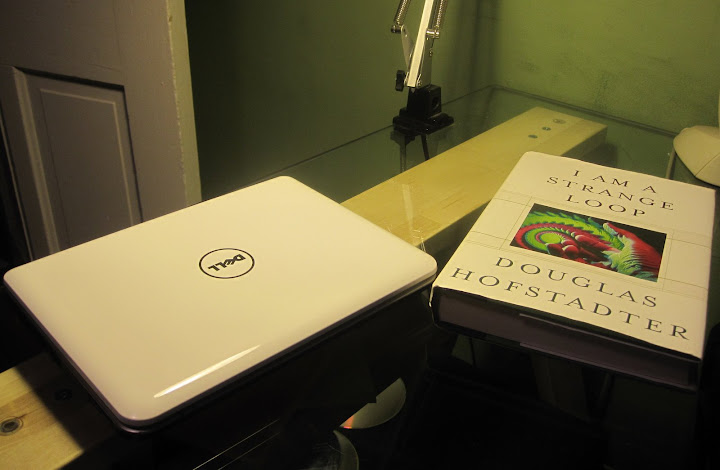
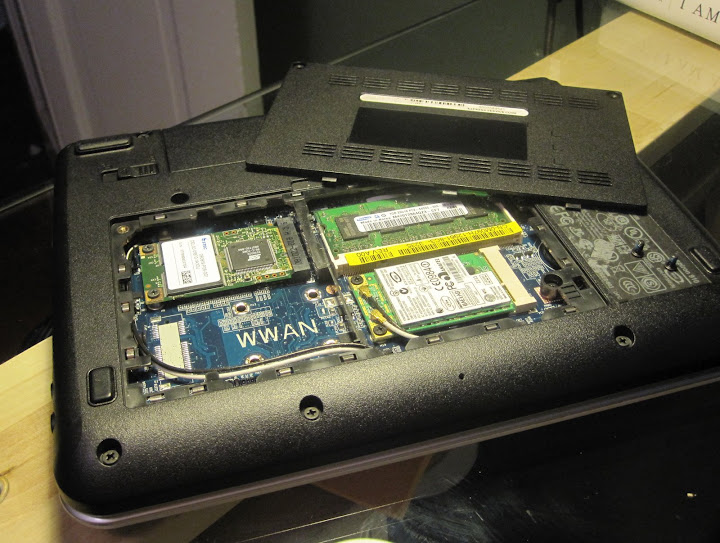
 My netbook is the Dell Mini 9 - "little-guy". It is about the same size and weight as a standard hardcover book (see above). The display is an amazing LED backlit display with great colors and contrast - it has been favorably compared to the MacBook Pro displays. The build quality is very solid. There are no moving parts in the entire chassis due to the low-power Atom processor enabling a fanless design and the use of a solid state drive. In addition, every component is extremely easy to access - requiring only the removal of 2 screws to get to the wifi card, hard drive and RAM (see below). On the standard 4-cell battery it gets about 4 hours of battery life on full brightness with wireless enabled.
There are two caveats. First, the keyboard is wonky due to the 9" form factor. Dell decided to sacrifice the standard layout to ensure that the letters were near normal size. My typing speed is about 20% slower than on a full-size keyboard when punctuation is required. Also the solid state drive in the base model is only 4GB. Since most of my data is on the cloud, this isn't a big deal. If you need more space, there is an SD HC slot on the side and the hard drive is easily replaceable.
The base Dell install of Ubuntu 8.04 is okay, but not excellent. The OS is bundled with the Yahoo web apps suite linked everywhere, which was frustrating since I live on the Google cloud. The application launcher was very well done. Software updates were a pain since Dell used an LPIA Linux kernel instead of the more ubiquitous i386 kernel. In usage, there is no difference, but it does mean that the package manager is severely limited. You can also order the computer with Windows XP.
All in all, I think the form factor of the Mini 9 is well worth it, and doubt I would toss it around as much if it were slightly bigger. The keyboard can be overcome, especially when you recognize that it is meant to be a secondary computer. If I need to do serious work, I'll get on my desktop.
Other Reccomendations
LifeHacker has an excellent Hive Five article on netbooks: Five Best Netbooks. It focuses on 10" models, which seem to be the emerging standard. The Asus 1000HE has received much praise.
If you are interested in a 9", the Dell Vostro A90 is the same as the Mini 9. The Mini 9 has been removed from the main page, but it appears you can order it here.
Purchasing Notes
If you are an IU student looking to purchase a netbook, remember the IU Dell Partnership Program. You'll be asked to authenticate via CAS and then taken to a custom Dell page with 7-12% discounts on all items.
Everyone should look into the Dell Outlet. The prices are severely lowered and all computers come with a standard 1-year warranty. My Mini 9 came from the outlet, and I have been completely satisfied.
Six months ago I got a refurbished Dell Mini 9 netbook for $240 from Dell Outlet. The size still elicits a "wow" - at every lecture this semester neighbors have asked if they can play with it. (sometimes during the talk!) The overall netbook market has settled on a 10" standard.
General Notes
Hardware
There are dozens of netbooks and almost all of them have the exact same specs: 1.6GHz Intel Atom processor, 1GB RAM, no DVD drive, 9-10" screen, integrated graphics, 1024x600 resolution, and a webcam of some sort. Things that will vary widely are battery life and keyboard size.
The lack of a DVD drive will probably bother some people, as will the presence of integrated graphics. Both of these are non-essential to the netbook philosophy, which dictates that everything important is on the internet. If not, you need a more powerful computer anyways. nVidia's Ion platform aims to change the graphics issues, but has seen slow adoption.
Operating Systems
Windows 7 has been touted as the best choice for a Windows netbook experience. Although not formally launching until October 2009, the release candidate can be easily acquired. The redesigned task bar helps promote minimalism and new optimizations make it run smoother than previous Windows incarnations. Vista is all but impossible to use functionally. XP is offered on almost all netbooks, and is the preferred choice over Vista.
I prefer Linux, which has finally matured enough for mainstream use. Several vendors ship with Ubuntu Linux. I find that Ubuntu to be far more usable than Windows, especially the painless updates and streamlined software download and install process. I tried the Ubuntu Netbook Remix (UNR) which is optimized for small screens, but I wasn't a fan of the particular application launcher. My final configuration was a self-remixed version of the Desktop Edition, adding the uses the Maximus, Window Picker, and Human Netbook Theme packages.
I just got an invite for the Jolicloud alpha, which looks like a promising netbook OS with a much better app launcher. I'll update with impressions later.
Specific Models
Dell Mini 9
 My netbook is the Dell Mini 9 - "little-guy". It is about the same size and weight as a standard hardcover book (see above). The display is an amazing LED backlit display with great colors and contrast - it has been favorably compared to the MacBook Pro displays. The build quality is very solid. There are no moving parts in the entire chassis due to the low-power Atom processor enabling a fanless design and the use of a solid state drive. In addition, every component is extremely easy to access - requiring only the removal of 2 screws to get to the wifi card, hard drive and RAM (see below). On the standard 4-cell battery it gets about 4 hours of battery life on full brightness with wireless enabled.
There are two caveats. First, the keyboard is wonky due to the 9" form factor. Dell decided to sacrifice the standard layout to ensure that the letters were near normal size. My typing speed is about 20% slower than on a full-size keyboard when punctuation is required. Also the solid state drive in the base model is only 4GB. Since most of my data is on the cloud, this isn't a big deal. If you need more space, there is an SD HC slot on the side and the hard drive is easily replaceable.
The base Dell install of Ubuntu 8.04 is okay, but not excellent. The OS is bundled with the Yahoo web apps suite linked everywhere, which was frustrating since I live on the Google cloud. The application launcher was very well done. Software updates were a pain since Dell used an LPIA Linux kernel instead of the more ubiquitous i386 kernel. In usage, there is no difference, but it does mean that the package manager is severely limited. You can also order the computer with Windows XP.
All in all, I think the form factor of the Mini 9 is well worth it, and doubt I would toss it around as much if it were slightly bigger. The keyboard can be overcome, especially when you recognize that it is meant to be a secondary computer. If I need to do serious work, I'll get on my desktop.
Other Reccomendations
LifeHacker has an excellent Hive Five article on netbooks: Five Best Netbooks. It focuses on 10" models, which seem to be the emerging standard. The Asus 1000HE has received much praise.
If you are interested in a 9", the Dell Vostro A90 is the same as the Mini 9. The Mini 9 has been removed from the main page, but it appears you can order it here.
Purchasing Notes
If you are an IU student looking to purchase a netbook, remember the IU Dell Partnership Program. You'll be asked to authenticate via CAS and then taken to a custom Dell page with 7-12% discounts on all items.
Everyone should look into the Dell Outlet. The prices are severely lowered and all computers come with a standard 1-year warranty. My Mini 9 came from the outlet, and I have been completely satisfied.
Thursday, July 16, 2009
Recovery
Just went to Bloomington Bone and Joint for another appointment with the doctor and therapist and they declared my elbow healed, with full motion and no restrictions! I'm extremely ecstatic as this was supposed to be a 6 week process, and I've done it in 3.
deCycles 2009 seems to have gone really well - Patti/Signe, Stacey, and Andrew got back on Sunday. The prevailing sentiment is that the trip brings you to overwhelming highs and lows, but it's a completely different mental state - one of those "you have to experience it" things. They all seem to have grown through the experience, especially in "get-up-and-go"-ness.
Of course I'm bummed that I couldn't finish the trip, and it sucks that I'm in every article as "one of the two who couldn't make it". I still made something out of the past two weeks though:
This year's deCycles is going to nag at me for a long time. There's not much of a silver lining, but dwelling on "might-have-beens" isn't gonna do anything. There's still the Hilly Hundred, a return trip to Wisconsin (potential route - Bike 4 Trails, Great River Road, Wisconsin River Valley, Madison) and maybe deCycles 2010. Things happen, so I'll take solace in only being down for 3 weeks.
deCycles 2009 seems to have gone really well - Patti/Signe, Stacey, and Andrew got back on Sunday. The prevailing sentiment is that the trip brings you to overwhelming highs and lows, but it's a completely different mental state - one of those "you have to experience it" things. They all seem to have grown through the experience, especially in "get-up-and-go"-ness.
Of course I'm bummed that I couldn't finish the trip, and it sucks that I'm in every article as "one of the two who couldn't make it". I still made something out of the past two weeks though:
- Put in over 30 hours, which turns into a lot of money.
- Earnestly started on the InPhO paper.
- Enjoyed some time reflecting and set two (reasonably) ambitious goals for the next year:
- Establish an emergency fund of $1,000 and leave debt behind by January.
- Publish/present at least 3 times by next May.
This year's deCycles is going to nag at me for a long time. There's not much of a silver lining, but dwelling on "might-have-beens" isn't gonna do anything. There's still the Hilly Hundred, a return trip to Wisconsin (potential route - Bike 4 Trails, Great River Road, Wisconsin River Valley, Madison) and maybe deCycles 2010. Things happen, so I'll take solace in only being down for 3 weeks.
Saturday, July 4, 2009
New Feeds
A few more sites to be aware of...
Humor
passive-agressive notes - Saw this site at NACAP two weeks ago during the Facebook Forum. If you like this kind of thing, you should subscribe.
Zero Punctuation - Yahtzee, the British-born Australia-based video game reviewer, is an unending source of comedy gold: Sims 3 review
Productivity
The Art of Nonconformity - This guy is awesome, and wants everyone else to be awesome too. I agree. Chris has some unconventional ideas on how to be awesome, but that's because awesomeness is unconventional. His life-manifesto "A Brief Guide for World Domination" is definitely worth reading. He also travels a bit. Start with the articles listed on his writings page, they're pretty cool.
The master subscription list has been updated.
New to RSS or Google Reader? How I Do Google Reader
Humor
passive-agressive notes - Saw this site at NACAP two weeks ago during the Facebook Forum. If you like this kind of thing, you should subscribe. Zero Punctuation - Yahtzee, the British-born Australia-based video game reviewer, is an unending source of comedy gold: Sims 3 reviewProductivity
The Art of Nonconformity - This guy is awesome, and wants everyone else to be awesome too. I agree. Chris has some unconventional ideas on how to be awesome, but that's because awesomeness is unconventional. His life-manifesto "A Brief Guide for World Domination" is definitely worth reading. He also travels a bit. Start with the articles listed on his writings page, they're pretty cool.The master subscription list has been updated.
New to RSS or Google Reader? How I Do Google Reader
Monday, June 29, 2009
Some Thoughts
So this blog is getting updated a little more frequently - hopefully, you are finding some useful tips. At this stage, I'm still a mere squidling (undergraduate), so you're getting a lot of redirects to other awesome things instead of novel ideas, but that's how life works. Hopefully I'm guiding you to the right places.
My elbow is healing up gradually - I can rotate my wrist almost entirely and my arm can almost straighten. Twisting my arm remains difficult. The progress is promising, but I still can't lift more than two pounds. Perhaps in two weeks I can meet up with deCycles in Lexington and finish the last 3 days of the ride.
It's not too bad being back in Bloomington. This weekend I started earnest work on the paper for InPhO. Right now I'm articulating how AI should be used to augment human feedback, without superseding it. I've also been working on some user interfaces and came across a really good Google Tech Talk, "Don't Make Me Click". Aza Raskin does a great job of emphasizing the importance of minimalist design and of doing as much as possible for your users. I found it worth the hour.
My elbow is healing up gradually - I can rotate my wrist almost entirely and my arm can almost straighten. Twisting my arm remains difficult. The progress is promising, but I still can't lift more than two pounds. Perhaps in two weeks I can meet up with deCycles in Lexington and finish the last 3 days of the ride.
It's not too bad being back in Bloomington. This weekend I started earnest work on the paper for InPhO. Right now I'm articulating how AI should be used to augment human feedback, without superseding it. I've also been working on some user interfaces and came across a really good Google Tech Talk, "Don't Make Me Click". Aza Raskin does a great job of emphasizing the importance of minimalist design and of doing as much as possible for your users. I found it worth the hour.
I've also been researching polyphasic sleep. Basically instead of sleeping 8 hours in a row, you have a shorter period of "core sleep" and then take 20 minute naps throughout the day. There are variations ranging from 6 hours of core sleep with a 30 minute nap in the day (Biphasic) to no core sleep and 6 20 minute naps throughout the day (Uberman) and a bunch of middle ground (Everyman). The less extreme versions are more pretentious ways of explaining what people do anyways, but the uberman concept is a fascinating extreme. Steve Pavlina has an interesting journal on adopting the uberman (day 30) (day 120) (going back). My roommate seems to have accidentally adopted the everyman system last year.
This month, I'm going to adopt biphasic sleep as my "thing" (although it seems this is how I naturally react to the school year). My only concern with adopting a true polyphasic sleep schedule is physical activity. No reports seem to have a regular exercise routine, and with 150+ miles of biking per week, I think core sleep may play a larger role in muscle recovery. For more findings on sleep, monitor my sleep tag on Delicious.
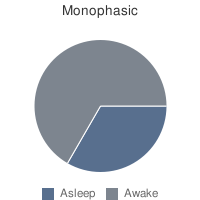
Some (public domain) visualizations of sleep patterns from Wikipedia:


This month, I'm going to adopt biphasic sleep as my "thing" (although it seems this is how I naturally react to the school year). My only concern with adopting a true polyphasic sleep schedule is physical activity. No reports seem to have a regular exercise routine, and with 150+ miles of biking per week, I think core sleep may play a larger role in muscle recovery. For more findings on sleep, monitor my sleep tag on Delicious.
Some (public domain) visualizations of sleep patterns from Wikipedia:


Subscribe to:
Posts (Atom)

 Posts
Posts

